Showing posts with label Politics. Show all posts

Monday, 22 May 2017


Donald Trump visits Israel as he continues Middle East trip


Donald Trump has arrived in Israel, the second destination on his five-stop Middle East trip.

The US president land at Ben-Gurion International Airport in Tel Aviv, where he was greeted by Israeli Prime Minister Benjamin Netanyahu and members of the Israeli cabinet.

Mr Netanyahu reportedly had to order ministers to attend the welcome ceremony at the airport, according to Israel's Haaretz newspaper, after he discovered a number were planning to skip the event.

Nonetheless, the arrival began with a lighthearted moment. As Mr Trump shook hands with Mr Netanyahu he asked, "What is the protocol?"

Throwing up his hands, Netanyahu replied: "Who knows?"

Later, in his formal welcome to the US president, Mr Netanyah said he hoped Mr Trump's visit would be a "historic milestone" in achieving regional peace.

Advertisement
MicroBarBox


While Mr Trump has said previously that finding a solution to the Israeli-Palestinian conflict is "maybe not as difficult as people have thought", few expect a breakthrough with this visit.

Indeed White House aides have tried to play down expectations, casting the trip as more symbolic than substantive.

The US president is expected to visit the Church of the Holy Sepulchre and the Western Wall, an important Jewish holy site, as part of his trip.

He will also meet Palestinian Authority President Mahmoud Abbas in Bethlehem on Tuesday.


Mr Trump arrives in Israel from a two-day visit to Saudi Arabia, where he called upon Middle Eastern leaders to combat a "crisis of Islamic extremism" originating from the region.

He also praised the Muslim world's history and culture, and declared Islam "one of the world's great faiths".

Monthly cocktail subscription box, craft gin club or buy individual gift boxes, all delivered to your door

That has been seen as something of a reset with the region following his presidential campaign, which was frequently punctured by bouts of anti-Islamic rhetoric.

Related Articles

🌎Donald Trump arrives in Israel amid tight security READ MORE

🌏DONALD TRUMP'S 28-HOUR ISRAELI AND PALESTINIAN TOUR ITINERARY IN FULL READ MORE

🌍'Ultimate peace deal' is goal as Donald Trump touches down in Israel READ MORE

Philippines' Duterte heads to Russia in blow to US


MANILA: Philippine President Rodrigo Duterte flies to Russia on Monday (May 22) to meet his hero, seek arms and steer his nation's foreign policy course further away from longtime ally the United States.

The five-day trip will cement a dramatic improvement in ties between the two nations since Duterte came to power last year and began unravelling the Philippines' decades-long alliances with the United States, which he accuses of hypocrisy and bullying.

Duterte will on Thursday meet Russian President Vladimir Putin, whom he has described as his "favourite hero" and proclaimed a personal bond because of mutual passions such as guns and hunting.

Duterte said on Friday one of the top priorities of his trip was to secure Russian precision-guided bombs to use on Islamist militants in the southern Philippines.

Advertisement
TT Trading Ltd - Lifetime Guaranteed Products

"If they can spare us with the precision guided (bombs)," Duterte said when discussing the purpose of his trip.

"We have so many smart bombs but not as accurate."

Duterte's seeking of weapons from Russia comes as he dials down cooperation with the United States, the Philippines' former colonial ruler that has for decades been its most important military ally and protector.

He has scaled down the number and scope of annual military exercises with the US, barred Filipino forces from joint patrols in the disputed South China Sea, and called for the withdrawal of American troops from the Philippines.
The shift occurred as China has become more assertive in challenging US might in the region by expanding its presence in the South China Sea, which it claims almost in its entirety.

Despite China's expansionism extending into areas of the sea claimed by the Philippines, Duterte has been determined to pivot his nation's foreign policy away from the United States in favour of Beijing and Moscow.

This has partly been due to China and Russia supporting or at least not criticising his controversial war on drugs, which has left thousands of people dead and led to warnings by rights groups that Duterte may be orchestrating a crime against humanity.

Duterte has railed against the United States, particularly when Barack Obama was president, for criticising the drug war.

'IDEOLOGICAL FLOW'

On a state visit to China last year, Duterte announced the Philippines' "separation" from the United States.

"I've realigned myself in your ideological flow and maybe I will also go to Russia to talk to Putin and tell him that there are three of us against the world - China, Philippines and Russia. It's the only way," he said in Beijing.

Duterte, who describes himself as a socialist, and Putin first met on the sidelines of an Asia-Pacific summit in Peru last November.

"Historically, I have been identified with the Western world. It was good until it lasted. And of late, I see a lot of these Western nations bullying small nations," Duterte told Putin then.

Since then, two Russian Navy flotillas have visited Manila.

TT Trading Ltd - Kitchen Knife Sets

"The Russians are with me, I shall not be afraid," Duterte said while touring the Russian Navy's guided missile cruiser Varyag during a port visit to Manila last month.

The Philippines and Russia established diplomatic ties 41 years ago but, until Duterte took office, relations remained relatively low key.

This was partly due to the Philippines' alliance with the United States.

Philippine-Russian trade last year totalled just US$226 million, according to government data. Philippine-US trade was worth more than US$18 billion last year.

Relations remain at the "nascent stage", but this will change, assistant Philippine foreign secretary Maria Cleofe Natividad told reporters in a briefing on Duterte's trip to Russia.

"We consider this visit as a landmark that will send a strong message of the Philippines' commitment to seek new partnerships and strengthen relations with non-traditional partners," she said.

Duterte visiting Moscow will be a "propaganda victory for Putin and a soft-power coup for Russia," Richard Javad Heydarian, a foreign policy analyst in Manila, told AFP.

"It will be their way of poking the eye of America."

Related Articles

🌏Rody wants Russian precision bombs READ MORE

🌎‘West is just double talk, I want more ties with Russia & China’ – Duterte READ MORE

🌍Recent developments surrounding the South China Sea READ MORE

Sunday, 21 May 2017

Rouhani’s victory is good news for Iran, but bad news for Trump and his Sunni allies


So it’s a good win for the Iranian regime – and its enormous population of young people – and a bad win for Trump’s regime, which would far rather have had an ex-judicial killer as Iranian president so that Americans would find it easy to hate him. Maybe Hassan Rouhani’s final-week assault on his grim rival candidate and his supporters – “those whose main decisions have only been executions and imprisonment over the past 38 years” – paid off. Who among Iran’s under 25s, more than 40 per cent of the population, would have wanted to vote for Ebrahim Raisi whose hands had touched the execution certificates of up to 8,000 political prisoners in 1988?

So the man who signed Iran’s nuclear agreement with the United States, who struggled (often vainly, it has to be said) to reap the economic rewards of this nuclear bomb “truce” with the West, who believed in a civil society not unlike that of former president Mohamed Khatami – who supported him in the election – won with 57 per cent of the vote, backed by 23½ million of the 41 million who cast their ballot. The corrupt and censorious old men of the Revolutionary Guard Corps and the bazaaris and the rural poor – the cannon fodder of the Iran-Iraq war as they often are in elections – have been told they no longer belong to the future.

Advertisement
Real Cloth Washable Nappies - lrclothing.com

But what a contrast this election has been to the vast congress of dictators and cut-throat autocrats greeting Donald Trump in Riyadh – just as the Iranian election results were announced. Save for Lebanon and Tunisia and Pakistan, almost every Muslim leader gathered in Saudi Arabia treats democracy as a joke or a farce – hence the 96 per cent victories of their leaders – or an irrelevancy. They are there to encourage Sunni Saudi Arabia’s thirst for war against Shia Iran and its allies. Which is why the Saudis will be appalled that a (comparatively) reasonable Iranian has won a (comparatively) free election that almost none of the 50 dictators gathering to meet Trump in Riyadh would ever dare to hold.

Real Cloth Washable Nappies - lrclothing.com

There are those who will remember, of course, that executions proceeded apace under Rouhani’s previous presidency – though not on the Golgotha scale of the 1988 executions – and that Rouhani’s revolutionary credentials are clear: just before Saddam Hussein’s Iraqi invasion of 1980, he managed to re-organise Iran’s tattered post-revolutionary army. But if Raisi symbolised the repressive past, Rouhani, however imperfectly, represents the future. For now.

Because everything depends on how he will respond to the madness of the Trump regime and its willingness to support the Sunni war machine with more than $100bn of weapons against Iran and its allies and friends. Rouhani must pray that Iran’s response can be political – he does at least have the satisfaction of knowing the voter turnout in Iran this week was 70 per cent against America’s miserable 58 per cent in the Trump-Clinton election last year. Iranians are a very political people and take their presidential polls seriously, even if only six out of 1,600 potential candidates were allowed to stand.

As they will the next man to be chosen as Supreme Leader when Khamenei departs. This critical position – without any precedent in Islam, it is now regarded as untouchable – could go to Ayatollah Sayed Mahmoud Hashemi Shahroudi, a man who, as head of the judiciary, reduced some of Iran’s more vicious punishments without being a true reformer. But this was true of old Hashemi Rafsanjani, the ex-president and Richelieu of Iran who died earlier this year. No one in Iranian politics can talk of reform and civil society without acknowledging the revolution and the martyrs of the 1980-88 Iran-Iraq war.

It was in the aftermath of this First World War-style conflict that the mass executions began. The only prominent cleric to stand against them was Ayatollah Ali Montazeri, whose courageous and moral decision cost him the Supreme Leadership. He spent the rest of his life under virtual house arrest. Khamenei took his place. And among the brutal men who then showed their “Islamisism” in the execution chamber, a massacre of prisoners that came to be known as the “national disaster”, Raisi could not expunge his name. Perhaps his only compensation today is that many of the Sunni Arab leaders gathered in Riyadh to applaud America’s mad President have almost as much blood on their hands. But they got “elected”.

Related Articles

🌎Trump seeks to win over Muslims with Islam speech READ MORE

🌍Trump in Saudi Arabia: US president to address Islamic leaders READ MORE

🌏Donald Trump to call for 'Muslim unity' in fight against terror during Saudi trip READ MORE

Thursday, 18 May 2017


What Does the President Owe, and to Whom Does He Owe It?


For the chronically indebted businessman Donald Trump, it was a win every day the creditors did not foreclose on him.

President Trump will manage the remainder of his presidency the same way.

The appointment of Robert Mueller as special counsel in the Trump-Russia matter will spell vexation in the medium term and may spell danger in the long term. But in the here and now—the next days and weeks, easing into months—the appointment brings relief.

Republicans in Congress have gained a new excuse to revert to their prior enabling of Trump’s misconduct: A special counsel has been appointed!

Instead of defiantly lying, the White House staff can now refuse to answer questions outright: A special counsel has been appointed!

Fundamental questions of national security and public integrity will go unexplored as the special counsel focuses on narrow legal matters. The public debate will be starved of new information as the special counsel proceeds in legally required secrecy.

Advertisement

Yet we can already perceive some of the legal first consequences of the appointment.

The special counsel will investigate whether the president’s message to James Comey about Michael Flynn—“I hope you can let this go”—followed by Comey’s firing, meet the test of prosecutable obstruction of justice. (Expect hundreds of hours of cable-TV airtime for anyone with plausible-sounding legal credentials willing to argue the contrary side of the case.)

Meanwhile, what happened in plain sight—the president fired an FBI director for doing his job—will dwindle into secondary importance.

The special counsel will investigate whether people in the Trump campaign violated any laws when they gleefully leveraged the fruits of Russian espionage to advance their campaign.

By contrast, what happened in plain sight—cheering rather than condemning a Russian attack on American democracy—will be treated as a non-issue, because it was not criminal, merely anti-democratic and disloyal.

If it can be proved that Flynn intentionally altered U.S. foreign policy in Turkey’s favor in knowing return for money, he will face legal jeopardy.

But if the motives cannot be proved beyond a reasonable doubt, the story will disappear from the inquiry.  

If the special counsel chooses, he may write a report providing larger context for the troubling events. The Trump Justice Department will then decide whether to release that report to the public.


The counsel’s mandate, however, only empowers him to investigate connections between Russia and the Trump campaign. It’s by no means clear that he has authority to broaden the inquiry into the mighty question of why Russia chose to intervene, or to explore entanglements between the Russian government and Trump’s businesses.

People in Trump’s orbit now face legal fees and legal jeopardy. For a long time however, the president himself will enjoy the shield of Robert Mueller’s professional discretion.

It doesn’t have to be this way. Congress could still investigate itself or empower an independent investigation. This Congress won’t. The next Congress should.

Perhaps it should start on exactly the terrain put off limits to Mueller: The pre-2015 history of connections between Trump and Russia. Congress has power to subpoena the business records of the Trump Organization. It can trace the complex system of holding companies within which (according to Trump biographer Timothy O’Brien) Trump hides his enormous debts. It can order a forensic audit to clarify exactly what the Trump family has received from Russian sources over the years, and what it may still owe.

Very likely none of this is illegal. It is, however, burningly relevant.

This generation’s variant of “What did the president know, and when he know it?” Is “What does the president owe, and to whom does he owe it?”

Not: “Is the president a crook?” (We had available all the information needed to determine that on election day.)

But: “Is the president a risk to national security?”

The most urgent task ahead is not a criminal investigation, potentially leading to indictments and prosecution.

The most urgent task ahead is a broader counter-espionage inquiry conducted not to mete out punishments, but to discover and publicize the truth, however disturbing.

Related Articles

🌍Trump Russia inquiry: Former FBI boss to lead probe READ MORE 

🌏Trump rails against 'witch hunt' amid special counsel appointment READ MORE

🌏Trump lambasts ‘witch hunt’ after ex-FBI boss named Russia probe chief READ MORE

Wednesday, 17 May 2017


Trump asked FBI's Comey to drop Flynn inquiry - reports


President Donald Trump asked FBI chief James Comey to drop an inquiry into links between his ex-national security adviser and Russia, US media report.

"I hope you can let this go," Mr Trump reportedly told Mr Comey after a White House meeting in February, according to a memo written by the ex-FBI director.

The memo was written immediately after the meeting, a day after Michael Flynn resigned, according to media reports.

The White House has denied the allegation in a statement.

Advertisement
Submit your 
content Every Day to 25 social 
bookmarking sites, all on unique 
C class IPs... FREE.

"The president has never asked Mr Comey or anyone else to end any investigation, including any investigation involving General Flynn," it said.

An influential Republican congressman has called for the FBI to hand over all relevant documents within a week.

Jason Chaffetz, who chairs the House Oversight Committee, demanded all correspondence relating to communications between Mr Comey and the president be presented by 24 May.

Mr Flynn was forced out in February after he misled the vice-president about his conversations with Russia's ambassador before Mr Trump took office.

The latest Russian twist, first reported by the New York Times, comes a week after Mr Trump fired Mr Comey over his handling of the FBI investigation into Hillary Clinton's use of a private email server while at the state department.

Mr Comey's dismissal sent shockwaves through Washington, with critics accusing the president of trying to thwart the FBI investigation into Russia's alleged interference in the US election and any Moscow ties to Trump associates.

What's the latest allegation?
Mr Comey reportedly wrote a memo following a meeting with the president on 14 February that revealed Mr Trump had asked him to close an investigation into Mr Flynn's actions.

He reportedly shared the memo with top FBI associates.

"I hope you can see your way clear to letting this go, to letting Flynn go," the president told Mr Comey, according to the memo. "He is a good guy."

Mr Comey did not respond to his request, according to the memo, but replied: "I agree he is a good guy."

In response to the report, a White House official pointed out that acting FBI director Andrew McCabe had testified last week that there had been "no effort to impede our investigation to date".

The I-word surfaces - Anthony Zurcher, BBC News, Washington
The "I" word - impeachment - has already been broached by politicians as moderate as independent Senator Angus King of Maine. If this were a Democratic-controlled House of Representatives, articles of impeachment would likely be in the drafting process.

Republicans still call the shots in Congress, however, and it's a significant leap to get them to abandon the Trump presidency and any hope of advancing their agenda for the foreseeable future.

But some, like Senator John McCain - who said this has become a scandal of "Watergate size and scale" - are clearly wavering.

The former Republican presidential nominee is a bit of a wild card, of course.

For the rank-and-file to turn on the president will require them to admit their complicity in a failed presidency.


Mr Flynn's departure in February came months after suspicions were raised among intelligence officials.

He resigned as White House national security adviser after just 23 days on the job over revelations that he had discussed lifting sanctions on Moscow with Russian ambassador Sergei Kislyak, before Mr Trump was sworn in.

It is illegal for private citizens to conduct US diplomacy.

Since Mr Flynn stepped down, the Pentagon has launched an investigation into whether he failed to disclose payments from Russian and Turkish lobbyists for speeches and consulting work.

Mr Flynn's Russian ties are under investigation by the FBI and the House and Senate Intelligence Committees, as part of wider inquiries into claims Moscow sought to tip the election in favour of Mr Trump.

Submit your 
content Every Day to 25 social 
bookmarking sites, all on unique 
C class IPs... FREE.

Adam Schiff, the highest ranked Democrat on the House Intelligence Committee, said this intervention by Mr Trump, if correct, amounted to "interference or obstruction of the investigation".

Senator John McCain reportedly said at a dinner that the Trump scandals had now reached "Watergate size".

The key legal statute is 18 US Code Section 1512, which contains a broad definition allowing charges to be brought against someone who "obstructs, influences, or impedes any official proceeding, or attempts to do so".

Section 1512 requires a person not only to attempt to obstruct justice but to do it with "corrupt" intent, and legal experts have told the Washington Post that is not clear in this case.

What is the US media saying?
An opinion piece in the New York Times, which first reported on Mr Comey's memo, expresses frustration with Republican lawmakers.

"When will Republicans in Congress decide that enough is enough?" it reads. "Do they need Mr. 

Trump's approval ratings to dip below 30%? Do they need first to ram through their deeply unpopular agenda? Or it is possible they might at last consult their consciences, and recall that they took an oath to uphold the Constitution?"
Dan Balz in the Washington Post says the Republican strategy of hoping the storm would pass has run aground, though many will continue to resist.

"But the double revelations of the past two days show that events are forcing a change in everyone's calculations," he writes.

Politico says Republicans are in a bind because the crisis could threaten their entire legislative programme.

"If Republicans are paralysed and can't pass anything despite control of the White House and Congress, how can they justify their majorities when they go before voters next year?" it says.

Meanwhile Tucker Carlson on Fox News urged viewers not to take everything they read at face value. He said "an awful lot of people in Washington" wanted to remove the president.

"What are their motives? In a lot of cases those are completely unknown. A lot of what you hear and accept uncritically you ought to question." he said.

Related Articles

🌍What would happen if Donald Trump were impeached? READ MORE

🌏Trump asked Comey to end investigation of Michael Flynn READ MORE

🌎Is impeachment possible? The James Comey memos that might destroy Donald Trump's presidency READ MORE

Monday, 15 May 2017

Emmanuel Macron names centre-right Edouard Philippe as French prime minister


Newly-inaugurated French President Emmanuel Macron appointed a conservative prime minister on Monday in a move to broaden his political appeal and weaken his opponents before legislative elections in June.

Edouard Philippe, 46, a lawmaker and mayor of port city Le Havre, is from the moderate wing of the main centre-right The Republicans party and will be a counterweight to former Socialist MPs who have joined Macron's cause. 

Elysee secretary-general Alexis Kohler made the announcement on the steps of the presidential Elysee palace.

Mr Macron has vowed to end the left-right politics which have dominated France for decades, and his start-up centrist Republic on the Move (REM) party, which is just a year old, needs to find a wide base of support for the parliamentary elections.

Mr Philippe is a close associate of former prime minister Alain Juppe, who leads the moderate wing of The Republicans and has indicated that he favours helping Macron. His appointment could draw more defectors from The Republicans.

Advertisement

On the other side of the political divide, Mr Macron's decision not to put up an REM candidate to oppose former Socialist prime minister Manuel Valls in his constituency ties Mr Valls closer and makes it hard for a divided left to re-unite.

It is the first time in modern French political history that a president has appointed a prime minister from outside his camp without being forced to by a defeat in parliamentary elections.

Mr Macron's presidential win itself was a seismic shift in a political landscape dominated for decades by the two main left-wing and right-wing parties.

By appointing Mr Philippe, Mr Macron has passed over some loyal followers including Richard Ferrand, a former Socialist who was one of the first to join Macron's cause last year and is secretary general of REM.


One of Mr Macron's close aides said on Sunday this was the kind of tough choice that would have to be made in Mr Macron's inner circle now that the battle for the Elysee was won.

"In government, you will see that a lot of the inner circle will drop out," Christophe Castaner, Macron's campaign spokesman, told journalists on the sidelines of the inaugural ceremony.

"I was among the first to say 'why not a prime minister from the right'? That's in the nature of what we are trying to do... It's tough... especially for the longest-serving ones," he said.

Mr Philippe began his political life as a Socialist activist affiliated to the former prime minister Michel Rocard while he was a student, before turning to the right.

A trained lawyer, he worked as public affairs director for the state nuclear group Areva between 2007 and 2010, before becoming a member of parliament in 2012, and then mayor of Le Havre in 2014.

Last year he was part of Juppe's unsuccessful campaign team in The Republicans' primaries, and then joined the presidential campaign of Francois Fillon, the party's nominee. Mr Philippe quit that cause when the financial scandal over fake jobs for Mr Fillon's family hit his campaign.

Mr Philippe, like Mr Macron, attended the elite ENA school, and his political hero is Rocard - another point in common with the 39 year-old new president.


The son of teachers, he likes to box in his spare time and collects cufflinks.

Related Articles

🌏Key Macron ally 'confident' French president can win parliamentary majority READ MORE

🌍The Latest: Germany chancellor welcomes new French president READ MORE

🌎Emmanuel Macron due to name 
PM on first day as French president READ MORE

Sunday, 14 May 2017

Trust in Theresa May will win the election, not personality or politics


David Blunkett used to say a successful government gets its betrayals in early. It is no less true that a campaigning party that senses it is going to lose an election starts honing its excuses long before polling day.

When on the back foot, Labour always complains about the media, and will do so again if it suffers a heavy defeat on 8 June. This time, however, the party is also preparing to blame its leader as unambiguously as possible: “It was Jezza wot lost it.” The resolve with which the movement is readying itself to throw Jeremy Corbyn under the bus is matched only by the certainty with which it re-elected him as leader eight months ago.

Advertisement

Look at the polls, say senior Labour figures: the voters love our policies, but will not accept Jeremy as a prospective prime minister. And there is some truth in this. According to a ComRes poll in the Mirror last week, the public expresses strong support for the party’s plans for renationalisation, income tax increases on those earning more than £80,000 a year and a cap on the state pension age.

Yet 56% of respondents thought Corbyn would be a “disaster” as prime minister. A YouGov survey in the Sunday Times told a similar story: broad support for many of Labour’s proposals, but not for a Labour government. Instead, Theresa May’s party has clambered to 49%, the highest mark recorded by YouGov in this campaign, 18 points ahead of the opposition.

From this stew of statistics is emerging a narrative that must be appealing in its simplicity: if only Labour were not held back by its inadequate leader, the party, with its glorious ideas, would already be romping home to Downing Street and the creation of a New Jerusalem. We’re right, we just picked the wrong guy.

Any student of the Tory opposition years will be all too familiar with this proposition. I remember the Conservative right in 2001 blaming defeat on William Hague rather than the totality of what the party had come to represent. Their solution was to elect Iain Duncan Smith as leader, who lasted only two years.


In politics, the distinction between identity and ideology is a wholly false dichotomy. Any quest for elective office depends upon the aggregation of policies in a candidacy, or multiple candidacies. A political party is much more than a clipboard for appealing proposals, an issue-based campaign body such as the RSPB or Save the Children. It is an organisation that seeks power for the leader and his or her team in order to enact a series of conviction-based policies. What Labour – not just Corbyn, but Labour – has lost is the capacity it had, not so long ago, to persuade the voters that it was up to the task.

In this respect, personality and plan are inextricable. The voters are far from stupid. They know that government is a perpetuum mobile of action, frustration, decision-making and, above all, a triage of time and resources. Proposals that are appealing when considered in isolation – as they are in the polls – are often undeliverable in practice, or deliverable only at the expense of something else that the electorate holds dear.

“The language of priorities,” said Aneurin Bevan, “is the religion of socialism.” In fact, it is the essence of all sound politics. But a party that simply waves a long list of desirable options in the voters’ faces is not speaking Bevan’s language. It is merely babbling.

Since the election was called, the Tories have pursued a mirror-image strategy to Labour’s. Aside from a handful of promises – on energy caps, overseas aid and council housing – the campaign has been entirely draped over the personality and character of the prime minister. Her cabinet, her party and its parliamentary candidates all linger in her shadow. This is, by design, a one-woman show.


And, so far, the strategy is working. The Tories know that the art of political persuasion observes a sequence. Trust and respect come first: without sufficient belief in the competence, trajectory and (always a problem for the Conservatives) motives of a party, it is sunk. Until these broad brushstrokes are painted to the voters’ satisfaction, nothing else matters.

Which is not to say that the Tory manifesto will be unimportant or a mere footnote in the story of May’s preordained march to glory. Precisely because its contents have been such a closely guarded secret, the weight of expectation it must satisfy is growing daily. Even if, as predicted, the finished document is slim, it should not appear deliberately undernourished.

It must also achieve three distinct objectives. First, and most obviously, it must present a blueprint for power that rises above mere generalities and slogans. Second, it has to liberate May from the myriad constraints of the 2015 manifesto, and the attendant impression that she is at the helm of a hand-me-down government.

And third, as the PM approaches her negotiations with Brussels, it must rid her of the outlandish and (in some cases) downright misleading claims of last year’s leave campaigns. There was never the slightest chance that departing the EU would yield a dividend for the NHS of £350m a week. But – until she has her own distinct mandate for Brexit – May will be dogged, not unreasonably, by this and the other promises of the 2016 referendum.

It is precisely because the hardest times lie ahead that she is seeking this mandate now. Cruel as it may be to say it, beating Corbyn is the least of her worries. Which is absolutely no consolation to Labour, as it ponders ways of explaining just why its supposed brilliance is so unlikely to be rewarded three weeks hence.

Related Articles

🌎General election 2017: Labour manifesto draft leaked READ MORE
🌎Mirror Politics morning briefing: Jeremy Corbyn's manifesto is populist AND popular (but he's still got an image problem) READ MORE


Analysis: Now the party's over, Emmanuel Macron must make some friends in politics as soon as possible 

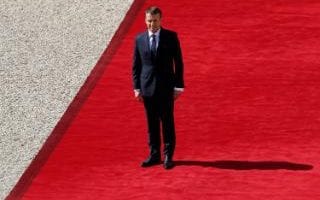
Nobody does pomp and circumstance like the British, but the French will be giving it their best shot when they inaugurate Emmanuel Macron as their 25th President in Paris today. It is a chance for a country that once had an Empire that stretched across the world to revive past glories.

The Republican Guard – infantry and cavalry dressed in their Napoleonic finery – will provide an escort, along with the trumpets and drums, throughout red-white-and-blue parades between the Élysée Palace and Arc de Triomphe. There will be a 21-gun salute from the Artillery, and a Chief of Protocol will ensure that the transfer of power from the outgoing head of state to the new one is carried out with the utmost decorum.

Advertisement
Wood Profits Banner

Unlike his predecessor, François Hollande, Macron never served in the French military, but he has a keen sense of history, and understands the solemn legacy of his new job. Presidents of France are far more powerful than English Royalty, and have to combine their quasi-monarchical duties with executive ones that also far exceed that of a British Prime Minister. This can be immensely challenging at the best of times, but for Macron the pressure of office is going to be absolutely enormous.

There will be no established constituency behind him when his fledgling party, La République en marche! (The Republic on the Move! or REM) contests crucial parliamentary elections next month.


Manuel Valls, right, speaks with then economy minister Macron during in Paris
As opposed to recent incumbents, Macron has never been an MP himself and, at the time of writing, he does not even have a shoo-in Prime Minister ready to act as his enforcer in the National Assembly, the French parliament’s lower house. One of the most astonishing features of the 39-year-old’s breathtaking rise to power is that Macron does not have any obvious political allies at all.

Wood Profits Banner

For a young pretender who wants to reform France into a business-friendly, fiscally responsible and institutionally sound EU giant, he urgently needs some.

REM is simply the name of the electoral vehicle - En Marche! - that brought Macron to power this month, with the word République stuck on. As such it sounds exactly like the kind of voting blocs that Charles de Gaulle, France’s wartime leader and the founder of the current Fifth Republic, rounded up at election time under even longer sets of initials.

De Gaulle was far more interested in the grand aspects of being President than the obviously political ones. He saw himself as an almost mystical figure marshalling an ancient fiefdom. In such circumstances party battles were by no means considered priorities.


The difference is that there were always plenty of high-profile Gaullists ready to assist the General with the nitty-gritty of government. In contrast, Macron is having great difficulty even finding enough credible REM candidates to cover France’s 577 electoral districts in time for June 11th, the first day of the two-round election. Those who have been chosen so far are meant to reflect renewal, but not necessarily talent.


More than half of the candidates named to date have no political experience at all. At 46, their average age is 14 years younger than those with seats in the outgoing Assembly. The male-female ratio is pretty much exactly 50:50, suggesting the emphasis is less about ability than representational correctness. Novelty newcomers range from a prize-winning mathematician to a former bullfighter.

Those who accuse Macron, a former unelected member of Hollande’s Socialist party (PS) government, of simply recycling the old order are certainly wrong. The number of MP defectors from the PS to REM on the election list so far is only 24.

Macron was not a member of the PS when in office, and the conspiracy theory that he was Hollande’s favoured successor is preposterous. Macron’s appointment as Economy Minister had far more to do with Hollande’s Prime Minister, Manuel Valls, and it led to liberalising measures that infuriated traditional Left-wingers in the Socialist camp.
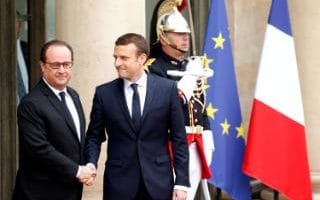
Outgoing French President Francois Hollande greets President-elect Emmanuel Macron who arrives to attend the handover ceremony at the Elysee Palace in Paris
Macron’s success in expanding Sunday trading as part of his very effective Loi Macron is little reported in Britain, for example. Following his collaboration with Valls, Macron had no interest in finding a senior role for his former colleague within REM, despite Valls wanting one after branding the PS dead “and behind us”.

Besides, Gaullist conservatives from the Républicains are also being tempted to join REM, in the wake of their suicidal decision to stick with François Fillon, an indicted criminal suspect, as their presidential candidate. As Fillon and his British-born wife, Penelope Fillon, prepare for the possibility of a trial and prison over a fake jobs scandal, there are likely to be some able Right-wing politicians tempted to ditch their blighted party for immediate power.

Nothing is certain, though, except that Macron will have diminishing time to deal with such tricky politicking. The magnificent spectacle of a French presidential inauguration will allow for another day of celebration, but the election festivities will be well and truly over by Monday morning. If Macron is going to cope with the weight of office, as well as his ambitious political agenda, he will need to find some capable friends very quickly indeed.

Related Articles

🌍The Guardian view on Europe’s new politics: all change READ MORE

🌍Macron’s Victory Explodes France’s Political Landscape READ MORE